
Colour Sheet Making Machine Roller Assembly
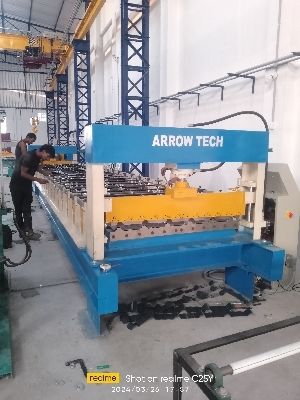

Colour Sheet Making Machine Roller Assembly Specification
- Type
- Colour Sheet Making Machine
- Material
- MS
- Computerized
- No
- Automatic Grade
- Automatic
- Control System
- Human Machine Interface
Colour Sheet Making Machine Roller Assembly Trade Information
- Minimum Order Quantity
- 1 Number
- Payment Terms
- Cash in Advance (CID), Cash on Delivery (COD), Cash Advance (CA), Cheque
- Supply Ability
- 3 Per Month
- Delivery Time
- 30 Days
- Sample Available
- Yes
- Sample Policy
- Free samples available with shipping and taxes paid by the buyer
- Main Export Market(s)
- Asia
- Main Domestic Market
- All India, South India, Tamil Nadu
About Colour Sheet Making Machine Roller Assembly
A color sheet making machine roller assembly typically refers to a component of a machine used in the printing or manufacturing industry to produce color sheets or rolls of various materials. The roller assembly plays a crucial role in the smooth operation and precise application of ink or other coloring agents onto the substrate material.
Here's a breakdown of the components and functions typically found in a color sheet making machine roller assembly:
1. Rollers: The assembly consists of multiple rollers, each serving a specific purpose:
- Inking Rollers: These rollers are responsible for applying ink or colorant onto the printing plate or directly onto the substrate material.
- Transfer Rollers: Transfer rollers help in transferring the ink or colorant from the inking rollers onto the substrate material.
- Impression Rollers: These rollers exert pressure on the substrate material to ensure proper contact between the inked plate and the material, facilitating the transfer of ink.
- Guide Rollers: Guide rollers are used to maintain proper alignment and tension of the substrate material as it passes through the machine.
- Cleaning Rollers: Some assemblies may include cleaning rollers to remove excess ink or debris from the other rollers, ensuring consistent performance.
2. Bearings and Shafts: Roller assemblies are mounted on bearings and shafts, allowing smooth rotation and movement of the rollers during operation.
3. Adjustment Mechanisms: To achieve precise control over ink application and substrate handling, roller assemblies often include adjustment mechanisms. These mechanisms allow operators to adjust factors such as roller pressure, ink flow, and substrate tension to optimize printing quality.
4. Construction Materials: Roller assemblies are typically constructed from durable materials such as steel, aluminum, or specialized alloys to withstand the rigors of continuous operation and maintain accuracy over time.
5. Drive System: Roller assemblies are driven by a motorized drive system, which may include belts, gears, or direct-drive mechanisms, depending on the specific design of the machine.
6. Safety Features: Modern roller assemblies may incorporate safety features such as guards, sensors, and emergency stop mechanisms to protect operators and prevent accidents during operation.
7. Cooling Systems: In high-speed printing applications or when dealing with heat-sensitive materials, roller assemblies may include cooling systems to dissipate heat generated during operation and prevent damage to the substrate material or the rollers themselves.
Superior Automation and Control
This colour sheet making machine roller assembly features state-of-the-art automation with a PLC control system and an intuitive touchscreen human-machine interface. Operators can easily manage workflow and monitor quality, ensuring precision and reducing the risk of manual error. The automatic grade maximizes output and consistency, making it an ideal solution for large-scale industrial environments.
Robust Construction for Extended Service
Built from high-grade steel alloy and MS materials, and finished with chrome plating, the roller assembly guarantees longevity and corrosion resistance. The structure's 12-tonne weight and substantial dimensions deliver both strength and reliability, enabling consistent operation under heavy loads and demanding conditions without compromising safety or performance.
Efficient Production Capacity
Capable of handling up to 25 tons in an 8-hour shift, this machine roller assembly is designed for high-throughput industrial usage. With a tolerance of 10mm, it meets diverse production requirements with precision. The 2D drawing support further simplifies setup and integration into existing manufacturing lines, enhancing operational flexibility.
FAQ's of Colour Sheet Making Machine Roller Assembly:
Q: How does the QC system improve the performance of the roller assembly?
A: The integrated QC (Quality Control) system monitors sheet quality throughout production, identifying and correcting inconsistencies in real time. This ensures that every output meets the specified tolerances, minimizes waste, and optimizes product consistency.Q: What type of industries can benefit from this colour sheet making machine roller assembly?
A: Industries involved in metal sheet production, construction materials, and manufacturing sectors requiring high-volume, precise colour-coated sheets can significantly benefit from this machine due to its high capacity, durability, and automation features.Q: When is maintenance required for the machine roller assembly?
A: Routine maintenance is recommended at scheduled intervals, typically after extensive usage or a predefined number of cycles, which can be monitored via the PLC control system. Regular checks ensure longevity and consistent performance, while the one-year warranty provides added assurance.Q: Where can this machine assembly be installed?
A: This machine is primarily intended for installation in industrial production facilities, especially those equipped for high-voltage operations (240V) and supporting large equipment with ample floor space to accommodate its 6*32*6 dimensions.Q: What is the process for operating the automatic roller assembly?
A: Operators initiate the process via the PLC control system with the touchscreen interface. The automatic system manages roller movement, colour sheet forming, and quality monitoring, requiring minimal manual intervention and ensuring uniform output throughout the production cycle.Q: How is the machine surface protected against wear and corrosion?
A: The roller assembly features a chrome-plated surface treatment, offering excellent resistance to wear, corrosion, and environmental factors commonly encountered in industrial settings. This enhances durability and maintains smooth operation over time.Q: What are the primary benefits of using this machine for industrial sheet production?
A: Key benefits include high production capacity, consistent quality due to built-in QC, reduced manual effort through automation, extended machine life from robust construction, and user-friendly operation via a modern touchscreen interface.Tell us about your requirement

Price:
Quantity
Select Unit
- 50
- 100
- 200
- 250
- 500
- 1000+
Additional detail
Mobile number
Email

More Products in Sheet Forming Machine Category
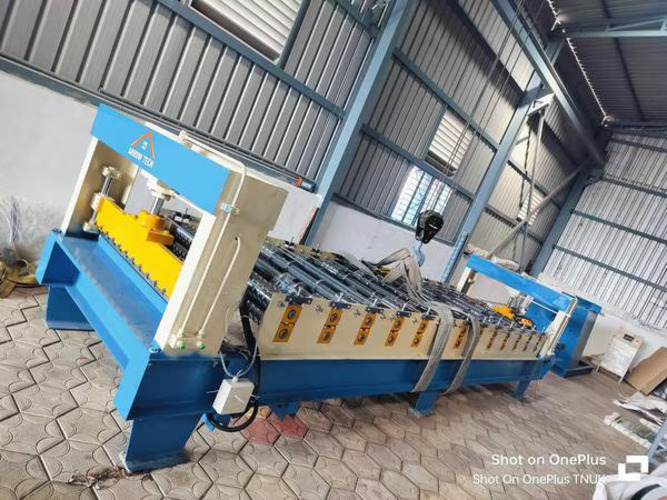
Roofing sheet forming machine
Price 2500000 INR / Number
Minimum Order Quantity : 1 Number
Control System : PLC Control
Color : Blue/Customized
Type : Roofing sheet forming machine
Material : Steel (frame and components)
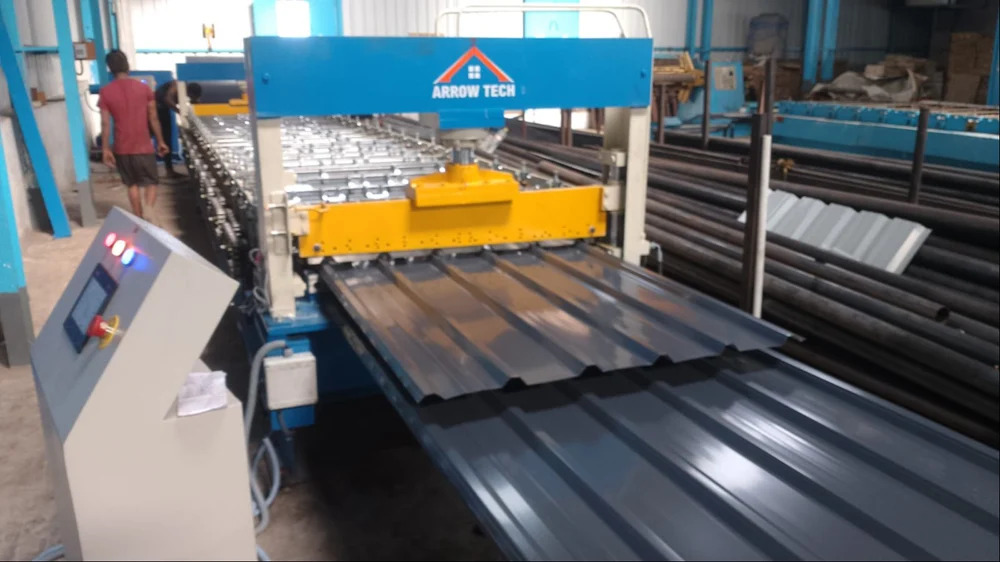
Roof roll forming machine
Price 350000.0 INR / Unit
Minimum Order Quantity : 1 Unit
Control System : Human Machine Interface
Color : Blue paint Coated
Type : Sheet Roll Forming Machine
Material : MS
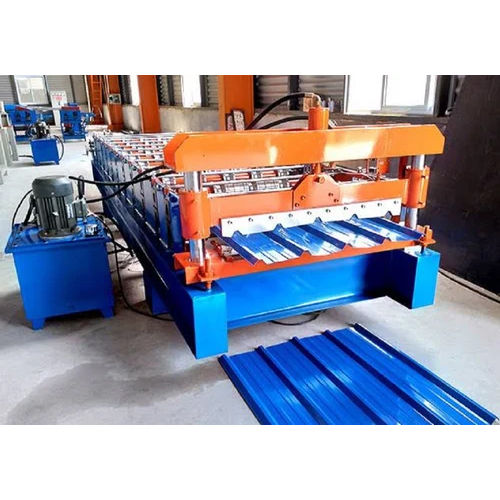
Metal Roofing Sheet Forming Machine
Price 1500000 INR / Unit
Minimum Order Quantity : 1 Unit
Control System : Human Machine Interface
Color : Multicolor paint Coated
Type : Metal Roofing Sheet Forming Machine
Material : MS

Contact Details

- SF No.83, No.6a2, Vilankuruchi Road, R K Puram,Coimbatore - 641035, Tamil Nadu, India
- Phone : 9500239540
Arrowtech Engineering
GST : 33EUJPS3022P1Z7

- Mr. Saravanan Mani (Proprietor )
- Mobile : 08045816824
-
 Send Inquiry
 Send Inquiry
 Our Products

 Send Inquiry
 Send SMS
Arrowtech Engineering
All Rights Reserved.(Terms of Use)
Developed and Managed by Infocom Network Private Limited.
Developed and Managed by Infocom Network Private Limited.
